In Fair Verona
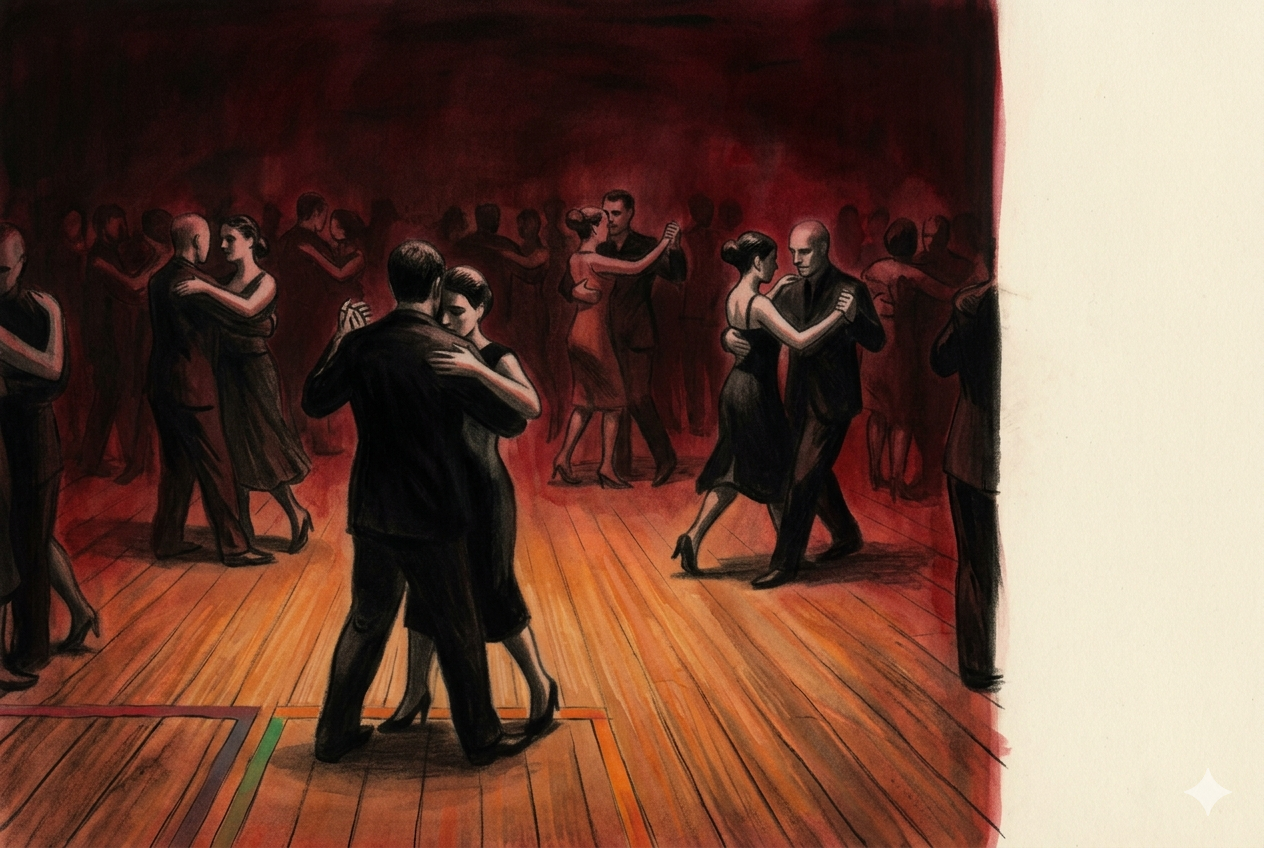
Thirty strangers. One weekend. A tango-LARP where dance was the only language.
What it felt like to play
You arrive knowing neither tango nor your character. By the end of the weekend you will know both.
The workshop teaches you the steps. Then it teaches you something harder: how to say things with your body that you cannot say with words. You practice dancing heavy and light, open and closed, willing and reluctant. You learn that the lead is not control, it is an offer. And the follow is not submission, it is a response.
Then you meet your scene partner. Your character’s former lover, who now despises you. You have to dance together. He leads, soft and uncertain. You resist. He adjusts. You resist more. Something passes between you that has no name and needs none. You laugh afterwards because the moment was almost too much.
You build the town with tape on the floor. A main street, a church, a speakeasy with a back room. And a sleazy motel at the end of the strip. Everyone knows what dancing in there means. Nobody has to say it.
In the third act your former lover finds you again. He dances with you slowly, so slowly. Your character feels the relief of return. The song winds down and you stand together in silence, held.
The next song starts with a single loud note. He is gone. One movement, one beat, and he is across the floor with someone else. You stand alone in the middle of a passionate dance floor, surrounded by story that isn’t yours anymore.
Inside you are screaming: this is so good.
The design challenge
Dance had to be the heart of the game. Not decoration, not interruption, the core mechanic. That decision made everything harder.
Larp is a verbal medium. The moment you move the heart of the game into the body, most of your design tools stop working. You are essentially starting over.
At the same time we wanted to eliminate preparation entirely. No prior experience with tango. No prior experience with larp. No homework. Anyone should be able to walk in and play.
Both ambitions at once felt close to impossible.
What it opened up
The fusion worked because each form covered the other’s blind spot. What couldn’t be spoken could be danced. What couldn’t be danced could be said. Together they gave players access to emotional territory that neither medium reaches alone.
The workshop wasn’t preparation for the game. It was the beginning of it. By the time the game started, every character existed, every relationship was established, every corner of the town had meaning. The players had built all of it themselves.
We designed the structure. Three acts, a flaw, a possible fate. The players invented everything inside it.
That turned out to be enough. More than enough.